
What are Incoterms?
INCOTERMS are a set of three-letter standard trade terms most commonly used in international contracts for the sale of goods. It is essential that you are aware of your terms of trade prior to shipment. You can find out more about them here.
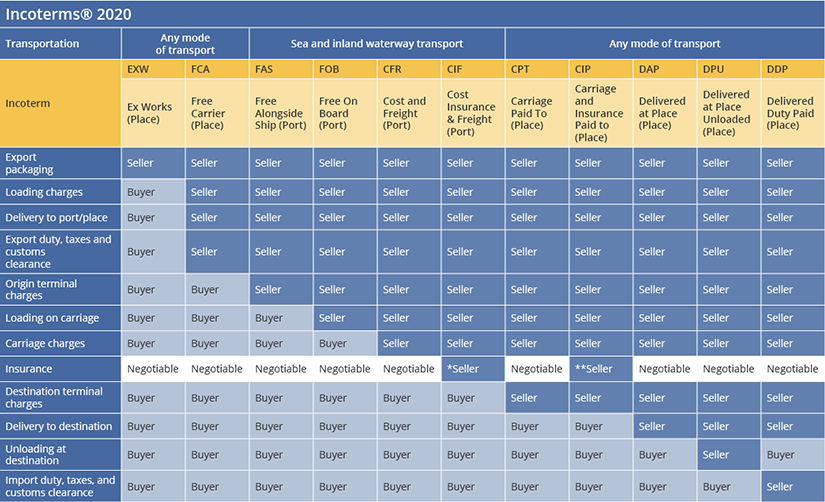
Any mode of Transport
- EXW (Ex Works) means that the seller makes the goods available at their premises, factory, or another named placed. The buyer has the maximum obligations and costs to move the cargo from the named placed to its final destination.
- FCA (Free Carrier) means that the seller delivers the goods (that have been cleared for export) to a named place (such as a carrier nominated by the buyer).
- CPT (Carriage Paid To) means that the seller pays for the carriage of the goods up to the named place of destination. However, the risk still transfers to the buyer when the goods have been handed over to the main carrier and they will be responsible for insuring the goods in transit.
- CIP (Carriage and Insurance Paid to) is largely similar to CPT except that the seller is also responsible for insurance. This incoterm requires that the seller insures the goods for 110% of its contract value and is usually in the same currency as the contract.
- DAP (Delivered At Place) means that the seller delivers the goods to the destination nominated by the buyer. The buyer is responsible for customs clearance and duties at the destination. The buyer is also responsible for unloading the goods at the destination.
- DPU (Delivered at Place Unloaded) is similar to DAP, but the seller is also responsible for unloading. As with DAP, the seller is responsible for all costs of transport. The buyer is responsible for customs clearance and duties at the destination.
- DDP (Delivered Duty Paid) is similar to DAP, but the seller is responsible for the import customs clearance and duties. The seller is not responsible for unloading. This incoterm places the maximum obligations on the seller and minimum obligations on the buyer.
Sea and Inland waterway transport
- FAS (Free Alongside Ship) means that the seller delivers the goods alongside the buyer’s vessel at the named port of shipment. This means that the buyer has to bear all the costs and risks from that moment. The seller is responsible for clearing the goods for export.
- FOB (Free On Board) means that the seller bears all costs and risks up to the point that the goods are loaded on board the vessel designated by the buyer. The seller will arrange for export clearance, while the buyer pays for marine freight transportation, insurance, and unloading & transportation costs at the destination. Since FCA, FOB should only be used for non-containerised seafreight and inland waterway transport.
- CFR (Cost and Freight) means that the seller pays for the carriage of the goods up to the named port of destination. The risk will transfer to the buyer when the goods have been loaded on board the ship. The seller is responsible for origin costs, while the buyer is responsible for all other costs. CFR should only be used for non-containerised seafreight and inland waterway transport, otherwise CPT should be considered.
- CIF (Cost, Insurance & Freight) is largely similar to CFR except that insurance is the responsibility of the seller. As with CIP, goods are required to be insured for 110% of the contract value of goods and is usually in the same currency as the contract. CIF should only be used for non-containerised seafreight and inland waterways transport, otherwise CIP should be considered.